From Every Waking Moment, Lynx House Press, 2021. Reprinted with permission. Available from Amazon and your local bookstore.
All I Want
Two decades without him, and all I want
is one of my father’s plain white T-shirts
draped over the back of a chair after work,
to trace the map of grease-stains and islands
leftover from his dried-out sweat.
To feel it peeling off his back as he asks
for another massage, and to give it this time
with full knowledge of how much pain he’s in,
without counting down the minutes
on his bedside clock.
To see that jade cross
dangling beneath the band of his V-neck
as he bends to tend the tomatoes, to ask
why he dug it out of a flea market box
and started wearing it those last months,
rubbing the stone when he thought
no one was looking.
To lift one of his T-shirts
out of the closet where I keep them, and feel
my hand reaching through the cotton weave
to work the knots from his aching back
one last time.
One of the basic questions we can ask ourselves is this: Who or what am I not appreciating right now? When my father was still alive, I seldom took the time to notice those work-shirts he’d shed as soon as he got home, draping them over the kitchen chairs. My father worked long hours as a maintenance mechanic at a factory that made plastic toolboxes until he grew too weak with Hepatitis C to keep it up. Now, of course, I’d give just about anything to be back in our old house some evening, watching as his rusty Dodge pick-up pulled into the driveway, seeing him smile as he threw open the screen door and greeted us all.
As I suggest in the poem, this time I would do what I could to care for him, fully aware that he kept the struggles of his illness hidden from us for years. I would not count down the minutes on the bedside clock until I was finished and could go watch TV again. And I would not roll my eyes or act put out if he asked me to work those knots from his back, believing I had better things to do with my time and energy. As fiction writer George Saunders once said in his now well-known commencement speech, “Some Thoughts on Kindness”: “What I regret most in my life are failures of kindness. Those moments when another human being was there, in front of me, suffering, and I responded…sensibly. Reservedly. Mildly.” We often dwell on those missteps of compassion once we lose someone, or miss the chance to make it right, yet we can forgive ourselves for being preoccupied (and thus human), for working with limited knowledge of the private pain of others. Perhaps instead of blaming ourselves for what we failed to do or say back then, we can resolve to stay more present to ourselves and those around us in the here and now.
Invitation for Writing & Reflection: Is there some time from the past that you’d return to and revise? If you could go back with the knowledge you have now, how might you change your actions and words? Once you think of an instance, you might try using the phrase, This time, I would . . . over and over, listing those things you’d do differently, perhaps with more presence and awareness this time.

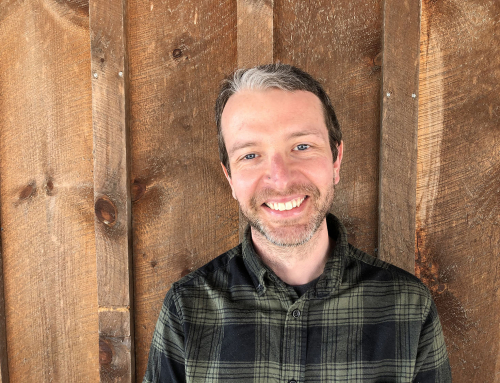
ABOUT THE AUTHOR: James Crews
James Crews is the editor of the best-selling anthology, How to Love the World, which has been featured on NPR’s Morning Edition, in the Boston Globe, and the Washington Post, and is the author of four prize-winning collections of poetry: The Book of What Stays, Telling My Father, Bluebird, and Every Waking Moment. His poems have been reprinted in the New York Times Magazine, Ploughshares, The New Republic, and The Christian Century, and in former US poet laureate Ted Kooser’s weekly newspaper column, “American Life in Poetry,” and featured on Tracy K. Smith’s podcast, The Slowdown. Crews holds an MFA in creative writing from the University of Wisconsin–Madison and a PhD in writing and literature from the University of Nebraska–Lincoln. He teaches poetry at the University at Albany and lives with his husband in Shaftsbury, Vermont.
FURTHER EXPLORATION
Thank you for reading. Please enjoy these works by James Crews. A portion of all online purchases through the links below goes to support Gwarlingo. You can also look for them at your local bookstore.


Thanks to hundreds of readers who have given donations big and small, Gwarlingo remains ad-free. Donors who give $50 become members. If you love Gwarlingo, please consider giving back.