Climbing the Golden Mountain
by Michael Kiesow Moore
. . . and silence is the golden mountain.
—Jack Kerouac
Listen. Turn
everything
off. When
the noise
of our lives
drifts away,
when the
chatter of
our minds
sinks into
that perfect
lake of nothing,
then, oh
then we can
apprehend
that golden
mountain,
always there,
waiting for
us to be
still enough
to hear it.
From The Song Castle, Nodin Press, 2019.
Reprinted with permission.

Read this and other poems by Michael Kiesow Moore in The Song Castle, available for purchase online.
Because my mind feels so full of “chatter,” I have had to learn ways to adapt, especially since we now have so many potential distractions at hand. For instance, I no longer sleep with my phone next to my bed, and try to stick to the rule of no texting or web-browsing after 8pm, no screens at all after 9. Sometimes, if I’m home alone and feel myself overly drawn into social media or work emails, I’ll unplug the wifi router and put away my phone, gifting myself with at least a few hours of what I call “soul time” in order to get back in touch with myself. We each have to find the ways that work best for us, yet I appreciate Michael Kiesow Moore’s opening invitation in this poem, to “listen” to all the noise our devices create in our lives, and then to “Turn everything off,” and feel the difference for ourselves. I often have trouble letting go of the speed and busyness of work that follows me for the rest of the evening (especially now that I work from home), and no matter how much I can see “that golden mountain” of silence waiting off in the distance, it is much more tantalizing and easy to keep feeding the frenzy and stress.
I remember once being on a silent meditation retreat for five days, and having so much trouble quieting my mind that I began making plans to leave. Yet I kept at it in spite of my resistance, and during one of the seemingly endless meditation sessions, with both legs numb and aching, I felt a sudden shift inside. Then I was finally able to “sink into that perfect lake of nothing.” The spacious emptiness didn’t last for more than a few moments, but I carried that slowness with me for several weeks, even after the retreat was over, knowing that any stillness we create in our lives is “a golden mountain” we’ll have to keep finding again and again each day.
Invitation for Writing & Reflection: Over the next week, watch for moments when you feel anxious or overwhelmed by news, social media, or work commitments. If and when you can, turn off or put away all of your devices, gifting yourself with even a small amount of total quiet. Later on, free write about the silence you allowed yourself to slip into. Was it difficult at first, or did the stillness feel welcoming from the beginning?

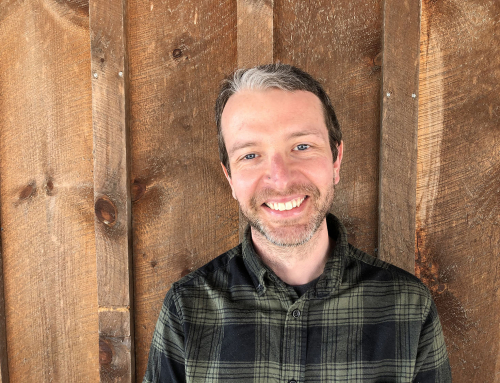
ABOUT THE POET: Michael Kiesow Moore
Michael Kiesow Moore is the author of the poetry collections What to Pray For and The Song Castle (Nodin Press). His work has appeared in many journals such as Poetry City and Water~Stone Review, anthologies like Lovejets: Queer Male Poets on 200 Years of Walt Whitman, Among the Leaves: Queer Male Poets on the Midwestern Experience and A Loving Testimony: Losing Loved Ones Lost to AIDS, and Garrison Keillor’s “The Writer’s Almanac.” Michael has received awards for his writing, nominations for the Minnesota Book Award and Pushcart Prize for poetry, and he founded the Birchbark Books Reading Series. When he isn’t drinking too much coffee, Michael can be found in Saint Paul, Minnesota dancing with the Braggarts Morris dancers.
POETRY SELECTION AND COMMENTARY BY JAMES CREWS
James Crews is the author of four collections of poetry: The Book of What Stays, Telling My Father, Bluebird, and Every Waking Moment. He is also the editor of two anthologies: Healing the Divide: Poems of Kindness and Connection and How to Love the World: Poems of Gratitude and Hope. His poems have appeared in Ploughshares, The New Republic, The New York Times Magazine, The Sun, and have been reprinted in Ted Kooser’s American Life in Poetry and featured on Tracy K. Smith’s podcast, The Slowdown. James teaches at SUNY-Albany and lives with his husband in Vermont.
Thanks to hundreds of readers who have given donations big and small, Gwarlingo remains ad-free. Donors who give $50 become members. If you love Gwarlingo, please consider giving back.