From Our Shadows
by W.S. Merwin
There were so many words for sadness
and for joy so few
maybe none
that can tell
the sound of that secret spring
welling up from before words
though when its voice rises
within us
we want to be able to tell
someone about it
if they will stay to hear
talk about
what is beyond words
sadness can rise in us
in the midst of happiness
and joy can take us by surprise
in the midst of great sadness
both of them know us
from before we were here
but if we speak to them
only sadness lingers
to hear us out
joy disappears
to wait for us it may be
where we least expect it
Originally published in Garden Time.
Copper Canyon Press, 2016.
Reprinted with permission.

Read this and other poems by W.S. Merwin in Garden Time, available for purchase online.
In this poem from his marvelous book, Garden Time, W.S. Merwin gets at the heart of a mystifying truth: It’s often easier to write or speak of grief than it is to describe some sudden burst of joy. “Only sadness lingers,” he says, and yet the happiness we most often want to stay (if only we could make it stay) soon “disappears,” without our knowing it. And sometimes, it’s only when the burst of joy has passed that we have enough perspective and insight to name it. One moment, I can feel absolutely grateful for my life and the world as it is, in tune with crows cawing from the tops of brushed-red maples and tractor trailers whizzing by on the highway—and the next moment, I’m resenting the noise of that traffic, consumed with tasks from my to-do list and the ever-present list of things that seem wrong with the world. I can show up at work, convinced that because I haven’t slept well, it’ll be an awful day, and then beneath the storyline of those thoughts, once I surrender to the work itself, I find a sudden happiness bubbling up out of nowhere. Perhaps, as Merwin gently suggests, part of what makes joy so mysterious and inviting is precisely the fact that it lives “beyond words”; we have no idea when “that secret spring” will rise up to refresh our hearts and minds. We must instead make peace with waiting for that pure, unalloyed joy to find us, accepting that we can never force it. And we can do our best to name and feel it fully before it begins to fade again.
Invitation for Writing & Reflection: The next time you feel a burst of joy like the one Merwin describes in his poem, see if you can pause, feel it fully, and name it. Take a few minutes to describe the sensation of that joy in the body and mind, even if you struggle at first to put it into words.

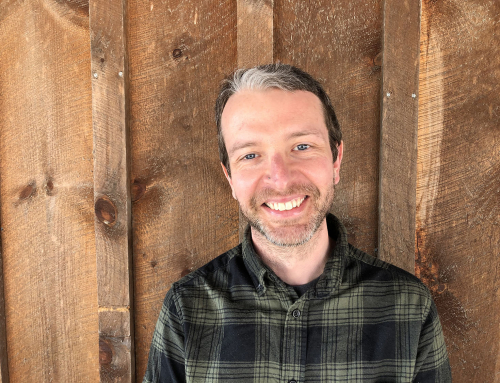
Photo by Matt Valentine
ABOUT THE POET: W.S. Merwin
W.S. Merwin was born in New York City in 1927 and was United States Poet Laureate in 2010. He graduated from Princeton University in 1948, where he studied with John Berryman and R.P. Blackmur. From 1949 to 1951 he worked as a tutor in France, Mallorca, and Portugal; for several years afterward he made the greater part of his living by translating from French, Spanish, Latin, and Portuguese. His first book of poetry, A Mask for Janus (1952) was selected by W.H. Auden for the Yale Younger Poets prize. After that, Merwin authored dozens of books of poetry and prose. His work embodied a bold commitment to experimentation and transformation rooted in the moral necessity of bearing witness, and was influenced by his profoundly environmentalist, pacifist, and anti–imperialist beliefs. He won many awards, as well as fellowships from the Rockefeller and the Guggenheim Foundations and the National Endowment for the Arts. W.S. Merwin passed away on March 15, 2019 at his home near Haiku-Pauwela, Hawaii. He was 91.
POETRY SELECTION AND COMMENTARY BY JAMES CREWS
James Crews is the author of four collections of poetry: The Book of What Stays, Telling My Father, Bluebird, and Every Waking Moment. He is also the editor of two anthologies: Healing the Divide: Poems of Kindness and Connection and How to Love the World: Poems of Gratitude and Hope. His poems have appeared in Ploughshares, The New Republic, The New York Times Magazine, The Sun, and have been reprinted in Ted Kooser’s American Life in Poetry and featured on Tracy K. Smith’s podcast, The Slowdown. James teaches at SUNY-Albany and lives with his husband in Vermont.
Thanks to hundreds of readers who have given donations big and small, Gwarlingo remains ad-free. Donors who give $50 become members. If you love Gwarlingo, please consider giving back.