
Kinship of Flesh
by Rebecca Foust
I swung my legs up to the table
as I always like to do
and saw another pair
swing up, identical
gesture, length and curve.
I saw your taper-finger,
knot-vein, walnut knuckle
hand just like Mom’s
and mine, somehow
knitting together years
miles, dollars, cultures
of division.
Visits, letters, calls, e-mails
dwindled
until it seemed we had less
in common than people I met
on line at the post office.
Then you sat down next me,
sister, and I saw
what I’d forgotten.

Read this and other poems by Rebecca Foust in Mom’s Canoe, Texas Review Press 2009, available from Amazon and your local bookstore.
During such divided times, it can be easy—when we disagree so fundamentally—to forget the humanity of other people. What might seem to us a gesture of supporting the greater good and the well-being of our society (like getting vaccinated, for instance), can just as easily seem to someone else a threat to their liberty, or a source of fear for their own health. What is perhaps most shocking at this point in the pandemic is just how separate we can feel from the people we love most, from family members with whom we share a “kinship of flesh,” as the title of Rebecca Foust’s poem points out. The speaker of the poem sees her sister’s legs swinging up onto the table, “identical” to her own, then looks down at her “hand just like Mom’s/ and mine, somehow/ knitting together years/miles, dollars, cultures/ of division,” and she realizes that she never stopped being connected to this person next to her, no matter how if often felt. With all the arguments, debates, and acrimony, it can be tough to see how “knitted together” we remain, whether we’re related or not, and I often think of what the Vietnamese Buddhist monk Thich Nhat Hanh has said, that we “inter-are.” In other words, we’re more helplessly interconnected as a species than we could ever imagine. The best we can do, perhaps, as Rebecca Foust also shows us, is to find some common ground with those with whom we disagree, and make a vow never to forget this kinship we share, no matter what we believe.
Invitation for Writing & Reflection: Describe a time when you were able to see and feel your way past the cultures of division in which we often find ourselves nowadays. What brought you back to the fact of our connectedness? How might you practice seeing the evidence of humanity and kinship in others who seem so separate and different from you?

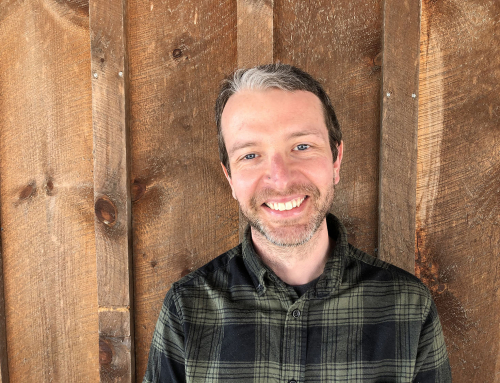
Photo by Jeremy Thornton
ABOUT THE POET: Rebecca Foust
Rebecca Foust is the author of three chapbooks and four books including ONLY, forthcoming from Four Way Books in 2022, with poems in The Hudson Review, Narrative, Ploughshares, POETRY, and Southern Review and elsewhere. Recognitions include the 2020 Pablo Neruda Prize for Poetry judged by Kaveh Akbar, the CP Cavafy and James Hearst poetry prizes, a Marin Poet Laureateship, and fellowships from The Frost Place, Hedgebrook, MacDowell, and Sewanee.
POETRY SELECTION AND COMMENTARY BY JAMES CREWS
James Crews is the author of four collections of poetry: The Book of What Stays, Telling My Father, Bluebird, and Every Waking Moment. He is also the editor of two anthologies: Healing the Divide: Poems of Kindness and Connection and How to Love the World: Poems of Gratitude and Hope. His poems have appeared in Ploughshares, The New Republic, The New York Times Magazine, The Sun, and have been reprinted in Ted Kooser’s American Life in Poetry and featured on Tracy K. Smith’s podcast, The Slowdown. James teaches at SUNY-Albany and lives with his husband in Vermont.
FURTHER EXPLORATION
Thank you for reading. Please enjoy these other works by Rebecca Foust. A portion of all online purchases through the links below goes to support Gwarlingo. You can also look for them at your local bookstore.


Thanks to hundreds of readers who have given donations big and small, Gwarlingo remains ad-free. Donors who give $50 become members. If you love Gwarlingo, please give back.



Thank you for saying so memorably here what I have several times tried to tell my daughters. I’m not sure the telling can do anything, really. I think the poem is right and this kinship has to be lived.