July 4th
This year, working from the coast of Nova Scotia, Canada Day on July 1 gets all the attention. But with July 4 quickly approaching, I find myself looking through firework photos from years past across American towns.


This year, working from the coast of Nova Scotia, Canada Day on July 1 gets all the attention. But with July 4 quickly approaching, I find myself looking through firework photos from years past across American towns.

Recently, I've come to appreciate the otherworldly powerline pruning of Historic Tremont in Cleveland, Ohio. "Training" trees to avoid overhead electrical lines isn't uncommon across America, but the wide swaths of space given to them in Tremont is quite something to behold.

A while ago now, driving through the outskirts of Las Vegas NM, I came across this artifact in a large, empty field...

Driving across America, it actually isn't unusual to end up passing through several towns with the same name. (For example, there are at least 25 Springfields alone, one reason Matt Groening chose it as the hometown of the Simpsons.)

One windy afternoon, as I was walking through a cemetery in Eastport, Maine, something caught my eye where the cemetery's edge receded into the woods.

Driving through the middle of Ohio, somewhere in the small town of Logan you see a small shed with brightly colored pencils painted on the outside. You might think "oh, what a nice space for art classes!" or "my, what a quaint art supply store!" Both excellent guesses. But if you instead said, "I bet that's a pencil sharpener museum!" then you were spot on.

Just down the street, I stumbled on this unique piece of ...art? Graffiti? Visual goodness.

riving through east Cleveland, you might stumble across the abandoned Warner and Swasey Observatory nestled into the edge of a residential community. Constructed in 1920, it was abandoned in 1980 when creeping light pollution had long since prevented it from serving its function of astronomical research.

While New Year's is now behind us, I was reminded of the holidays while looking at this vintage game board sitting on my shelf. Games have always been a staple of my family's gatherings, when we let go of our differences each year to compete over a rainbow-colored board with a common set of rules.
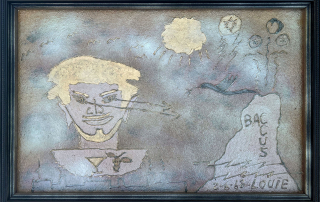
I recently had the pleasure to be reminded that beautiful artworks are not the sole domain of museums and galleries. Finding myself in a friend's basement, I was introduced to this gorgeous, fantastical painting by her half-uncle leaning against the wall. Shimmering shades of gold paint capture Walter James Lewis's ("Louie's") self-portrait from 1968.
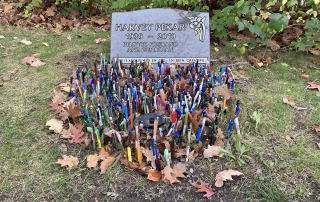
There's something singularly special about a pencil or a pen resting in our hand. It is a direct vehicle to channel our words, drawings, plans, ideas, and any other number of wonders residing in our heads. With that in mind, it's not unusual to see writers' and artists' graves covered in creative implements that visitors have deposited.

Walking through Alexandria, Virginia's Clermont Natural Park, park, a bit away from the playgrounds and baseball fields, you'll stumble on a singular underpass.

Sifting through ephemera in a used bookstore, I stumbled on a beautiful "tinted drawing papers" sample pack for the years 1924 and 1925. Manufactured by the Milton Bradley Company, this pack (with its now somewhat faded papers) is a beautiful construction.

Tucked away in a rural corner of America just at the edge of the woods sits a small, unassuming red house. It is a house like any other, decorated tastefully and well kept--with one very unusual feature. The ceiling, from wall to wall throughout, is plastered with stunning World War 2 era posters.

Earlier this week, as I struggled to open a package from the mail, I sighed and wished that boxes were better designed. But with it being almost Thanksgiving here in America, I knew the stores would already be full of Christmas wares. And, accordingly, some very interesting boxes!

At Cleveland's Riverside Cemetery, you’ll find the grave of Thomas “TOM” Joseph Baran. Well, technically just the headstone as Tom is presumably still alive and kicking. An engraved headstone speaks (literally, it is written on) of art and aesthetics, noting Cimabue and Giotto. It also has pictures of Superman; Jesus (many Jesuses); a corner devoted to a beloved poodle Clare; spends some time on Hegel’s concept of Geist; and it contains several telescopes and countless other wonders.

Maybe as a child you played the game “I spy with my little eye…“? Or on road trips, the license plate game? Or the letter game (things always get stuck on Q and Z)? I have fond memories of childhood trips driving across America whiling away the hours with things like these. I still love to wander, whether in the car or by foot, and am always on the lookout for new visual information...

Walking through Cleveland this week, I stumbled on "Trapped Tree" in a quiet corner of the city. This unusual moment, until recently hidden by brush deep in the Ohio City neighborhood, became uncovered as a new greenway opened alongside it.

What is the appeal of typologies? (Here, fire hydrants of Taos, New Mexico.) Is it bringing things across geography and squishing them together visually? Is it the delight of seeking and finding? Or maybe it is the joy at human inventiveness within specific limitations?

Erasure art is a special pleasure. Different from collage, which often assembles things from various sources, the act of making art through erasing depends on the form of the original to (some extent) staying intact. This week, we wondered what would happen if we erased the lines of a paint by number.

Strolling up the chilly Maine coast (and into Canada), you might start looking for seashells just as you would on many other beaches—but then you quickly notice an unusual proliferation of stripes. Stripes… on rocks. Big rocks, small rocks, in-between rocks… all decorated by a stunning variety of zips.

There have been artists who comb thrift stores for hidden treasures and sometimes you hear about a lost masterpiece found at a yard sale—but what about art with a slightly less glorious trajectory? We found this once-loved painting (it was framed after all) at a giveaway table at the local dump, as if its owner saw it not worth keeping nor worth finding a home for.

When you wander across an unfinished paint by number for sale, what are you to make of it?

One type of American roadside signs is those that have fallen into disrepair or become partially disassembled such that where there was once a sign, all that remains is a window to the world behind it. The “frame” of the sign, which previously kept some name, symbol, or slogan, now holds the space behind it—a shifting picture.

MASS MoCA curator Denise Markonish shares her stories of experiences with selected books featuring Nick Cave, Jen Bervin, Mary Ruefle, Barbara Bourland, Carl Belz, J.M. Arms Sheldon, and Camille Flammarion.